
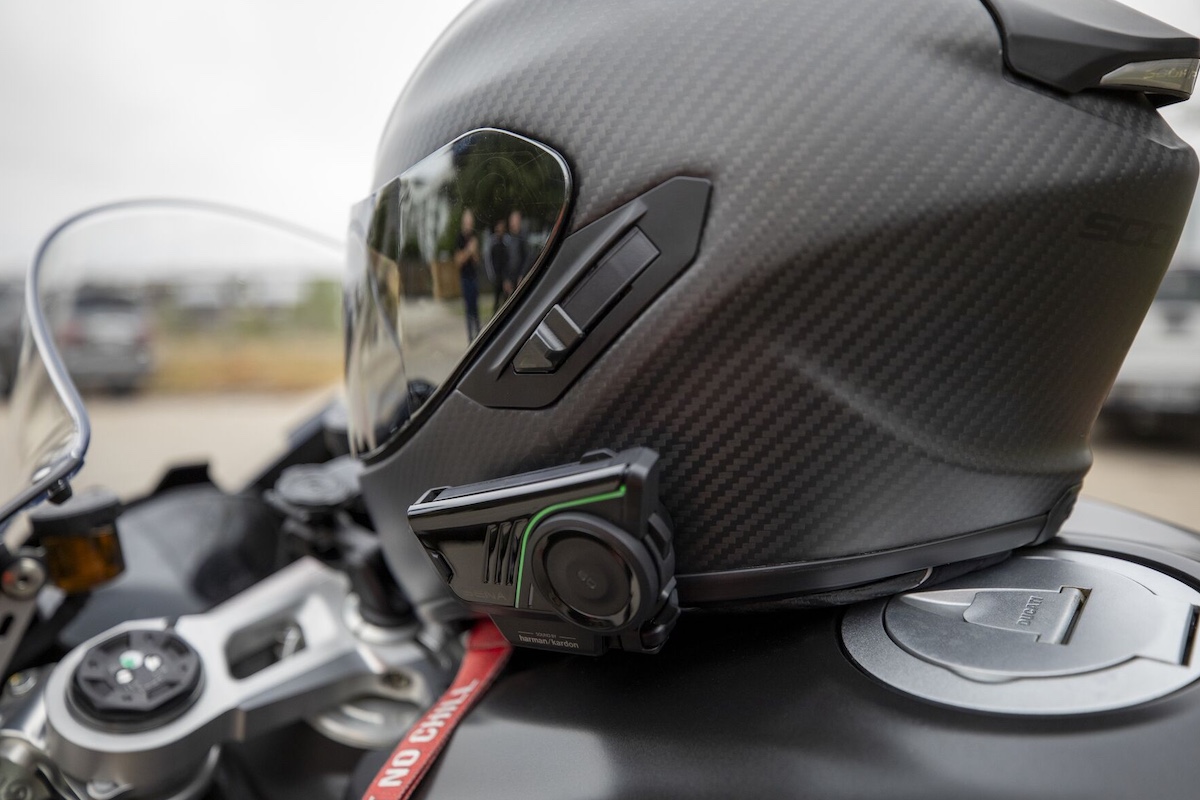
The best motorcycle Bluetooth intercoms on the market right now split into two technology camps: traditional Bluetooth pairing and the newer mesh networking systems.
Bluetooth intercoms work like a phone call — two devices talking directly to each other, with a finite range and a daisy-chain limitation on group size. Mesh systems are a different animal. They create a self-healing network among multiple units, automatically rerouting connections if someone drifts out of range. For group rides, mesh wins. For solo riders or two-up touring, traditional Bluetooth is still completely viable and often cheaper.
The two brands worth your attention are Cardo and Sena. Everything else — the no-name units from overseas, the budget brands with suspiciously glowing reviews — falls well short of what these two deliver. That’s not marketing loyalty, that’s just where the category actually is.
Both companies have been doing this long enough that their mid-range and flagship units are genuinely refined products. They also have competing wireless protocols that don’t natively talk to each other, though both have recently added cross-brand Bluetooth pairing as a workaround. Worth knowing going in.
Here’s an honest look at the intercoms worth considering, from the budget entry point to the flagship. If you’re also in the market for a new lid to go with a new comm unit, the best touring motorcycle helmets guide and the best modular helmets guide are good places to start — speaker pocket depth and chin bar geometry both matter when you’re fitting a new unit.
The Best Motorcycle Bluetooth Intercoms
1. Cardo PackTalk Edge — Best Overall Motorcycle Bluetooth Intercom

The PackTalk Edge is where Cardo stopped hedging and committed to a single design direction. Magnetic Air Mount, second-generation Dynamic Mesh Communication, 40mm JBL speakers, IP67 waterproofing, over-the-air firmware updates, and a roller wheel interface that you can actually operate with gloves on. That last point is more important than it sounds — plenty of intercoms with good audio turn into a fumbling mess once you’re wearing gauntlets at 60 mph.
The mesh networking on the Edge is legitimately impressive. It connects up to 15 riders in a group, heals itself automatically when someone drops out of range, and maintains audio quality that holds up better than traditional Bluetooth chains at distance. The “Hey Cardo” voice activation works well enough that you’ll actually use it, though it does occasionally interpret wind noise as a command, which makes for some interesting moments on the highway.
Where the Edge earns real points is the Air Mount system. Snap the unit off, swap it to a different helmet, snap it back on. The magnetic connection is secure enough that it doesn’t rattle or creep, and the mounting hardware is low-profile enough that it doesn’t look bolted-on when the unit’s not present. If you own multiple helmets — and if you’re into modular versus full-face decisions, you probably do — this actually matters.
The honest criticism: the roller wheel is small, and the buttons surrounding it are closer together than they should be. Cold days with thick gloves make precise operation harder than the marketing suggests. The app has also had its share of glitchy moments, though Cardo’s over-the-air update pipeline means firmware issues tend to get addressed faster than on units that require a cable connection to update. Battery life is strong — 13 hours of talk time is the claim, and real-world performance lands somewhere in that neighborhood.
At around a few hundred bucks on RevZilla, the Edge is premium-tier pricing. It’s worth it for group riders who want the best mesh system in the Cardo lineup, and for riders who prioritize the Air Mount flexibility. Solo riders and two-up tourers buying their first intercom might want to look at the Spirit HD below before committing to this price point.
Check it out at Revzilla
Check it out at Amazon
2. Sena 50S Harman Kardon — Best Sena Motorcycle Bluetooth Intercom

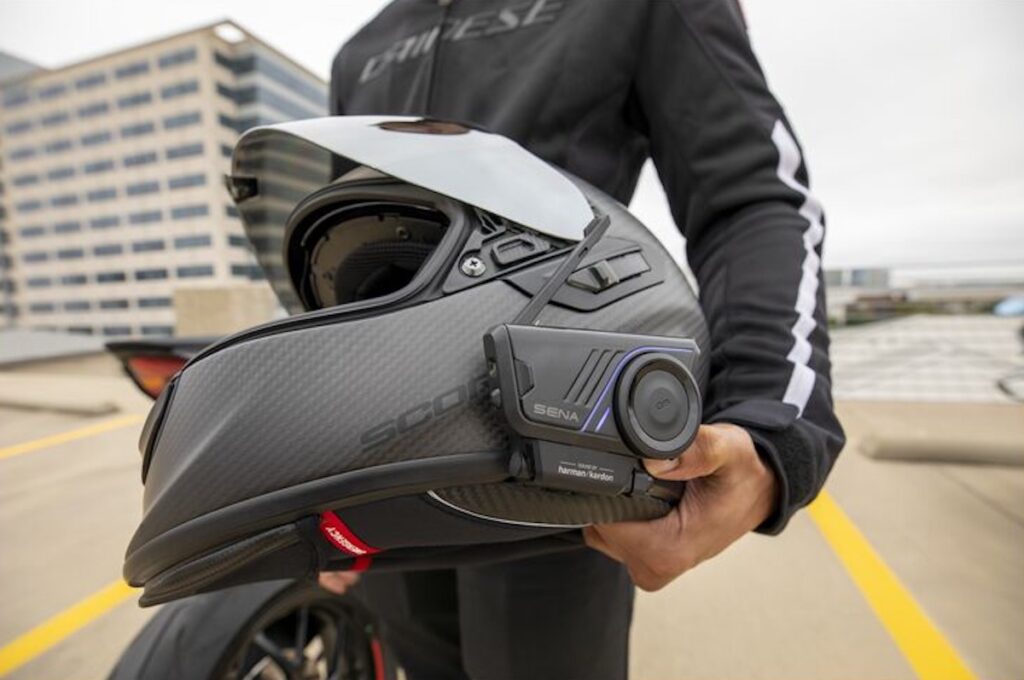
The 50S is Sena’s sweet spot — the unit that sits below the flagship 60S in price but still brings mesh networking, Harman Kardon audio hardware, and the large jog dial that makes Sena units easier to operate one-handed than most of the competition. If you’ve used an older Sena and liked the physical interface, the 50S will feel immediately familiar. If you haven’t, the jog dial is the kind of obvious-in-retrospect design decision that makes you wonder why more intercom manufacturers don’t do it.
Sena’s Mesh 2.0 connects up to 24 riders in a group mesh, with a range of up to 5 miles in open terrain. In practice, group mesh range is closer to a mile or two in anything other than flat, unobstructed conditions — which is still more than enough for most riding groups to stay connected. The 50S also offers multi-channel open mesh, which lets you share a channel with an unlimited number of riders, useful for organized group rides where you don’t need to be in a tight formation.
The Harman Kardon partnership is the unit’s biggest differentiator from previous Sena hardware. The speaker and microphone pairing is genuinely better than what came before — cleaner audio at speed, improved microphone performance in windy conditions, and a noticeable improvement in music playback quality over older Sena units. It’s not audiophile-grade, and it shouldn’t be — you’re on a motorcycle — but it’s good enough that you’ll actually enjoy using it for music and navigation, not just rider-to-rider communication.
One real limitation worth flagging: Sena’s mesh protocol doesn’t natively communicate with Cardo’s Dynamic Mesh Communication. If your riding group is a mix of Sena and Cardo users, you’ll be falling back to standard Bluetooth intercom pairing, which limits group size and range. Sena has added cross-brand Bluetooth pairing to address this, but it’s a workaround, not a solution. If your crew is already committed to one ecosystem, stay in it. If you’re buying first, make sure your group is buying the same brand.
The 50S represents strong value for the price in the mesh intercom category. It’s a mature, well-supported product from a company that’s been leading this space for a long time. The Sena brand page on the site has more context on their broader lineup if you want to see where this unit sits in the full product family.
Check it out at Revzilla
Check it out at Amazon
3. Cardo PackTalk Pro — Best Flagship Motorcycle Bluetooth Intercom

The PackTalk Pro is the Edge with a few additions that either matter a lot to you or matter not at all. The headline feature is crash detection — an IMU inside the unit monitors your ride and cross-references data with your phone’s sensors. If it detects a crash and you don’t cancel the alert within a set window, it sends your GPS location to an emergency contact. Whether that’s worth the price premium over the Edge is a genuinely personal decision, and it’s one of those features that’s hard to evaluate until you actually need it.
The Pro also upgrades to 45mm JBL speakers, a noticeable bump from the Edge’s 40mm units. The size difference translates to more low-end presence and better overall volume at highway speeds — the kind of thing that matters if you’re using the intercom for music playback on long touring days as much as for rider communication. Auto on/off, which powers the unit down when you remove your helmet and back on when you put it on, is the other addition worth knowing about. It’s a small convenience, but it’s the kind of thing you miss when it’s gone.
The honest criticism of the Pro is that it’s a large unit. The physical footprint is bigger than the Edge, and it sits higher on the helmet. On a dual sport or adventure helmet with a peak visor, the Pro can interfere with visor adjustment depending on your helmet’s geometry. On a standard full-face or modular lid, it’s less of an issue, but worth checking before you commit.
The Pro is the most expensive unit in this guide. It’s the right call for riders who want crash detection as a genuine safety net and who use their intercom for long hours of music playback where the speaker upgrade will be noticeable. It’s probably overkill for most riders, and Cardo knows this — the Edge exists precisely because most people don’t need everything the Pro offers.
4. Cardo Spirit HD — Best Budget Motorcycle Bluetooth Intercom

The Spirit HD is what you buy when you want a real intercom from a real brand without paying flagship prices. It’s not a mesh unit — this is traditional two-way Bluetooth communication, covering up to two riders at a range of about 0.4 miles. That’s enough for rider-passenger communication or riding with a single buddy who’s close enough to stay in range. For anything beyond that, you’ll want to step up to one of the mesh options above.
What you get for a really modest price is waterproofing, 40mm HD speakers, FM radio, over-the-air firmware updates via the Cardo Connect app, automatic volume adjustment based on ambient noise, and cross-brand Bluetooth compatibility. That last feature matters more than it used to — if your riding buddy already has a Sena and you’re buying a Cardo, the Spirit HD will pair with it over standard Bluetooth, even if you lose some features in the translation.
The Spirit HD won’t win any awards for button ergonomics — the controls are smaller and less tactile than what you get on the Edge or the 50S — and the two-rider limit is a real constraint for anyone who rides in groups. But for a solo rider who primarily wants GPS audio, phone calls, and occasional rider-passenger chats, this is a perfectly competent unit that does what it promises. Customer reviews consistently note that the audio is clearer than the price suggests, and that wind noise management is reasonable up to highway speeds, though not exceptional.
One thing to be aware of: the Spirit HD is Bluetooth-only, which means if your group ever grows beyond two, you’re the odd one out. If there’s any chance you’ll want mesh capability in the future, consider it a reason to stretch the budget now rather than replace the unit later. But if two riders is genuinely your use case — two-up touring, a spouse or regular riding partner — the Spirit HD is hard to argue with at this price.
Check it out at Revzilla
Check it out at Amazon
How to Choose the Right Motorcycle Bluetooth Intercom
The single most important question is how many riders you’re typically communicating with. If the answer is one — a passenger, or a single riding buddy who’s always right next to you — a Bluetooth-only unit like the Spirit HD is more than enough, and you’ll save significant money. If the answer is three or more, mesh networking isn’t optional. Traditional Bluetooth intercom chains degrade badly beyond two or three units, and the experience of being the person who dropped out of the chain on a group ride is frustrating enough to turn you off intercoms entirely.
The second consideration is helmet compatibility. Not every intercom fits every helmet cleanly. Most modern lids — particularly full-face helmets — have speaker pockets built into the liner padding, sized for the flat speaker pucks that both Cardo and Sena use. The microphone is the trickier part: modular helmets require a boom mic or a chin bar-mounted wired mic, while full-face helmets typically use a hybrid mic that mounts closer to the chin bar interior. If you’re buying a new helmet and a new intercom at the same time, verify fitment before you commit to either.
Brand ecosystem matters more than most buyers realize going in. Sena units talk to other Sena units natively over mesh. Cardo units talk to other Cardo units over DMC mesh. Cross-brand communication defaults to standard Bluetooth pairing, which works but lacks the range and group-size advantages of native mesh. If you’re the first person in your friend group to buy an intercom, you’re effectively voting on what everyone else should buy too. Worth a conversation before anyone pulls the trigger.
Finally, don’t overlook the physical interface. You will be operating this thing with gloves on, at speed, while paying primary attention to the road. The Sena jog dial is the most intuitive control scheme in the category. Cardo’s roller wheel on the Edge and Pro is good but smaller. The button layouts on budget units require more button-hunting. Test-ride this consideration in your head before dismissing it — how often you actually use the intercom’s features will depend partly on how accessible they feel through your gloves.
Frequently Asked Questions: Motorcycle Bluetooth Intercoms
What’s the difference between Bluetooth intercoms and mesh intercoms?
Traditional Bluetooth intercoms pair directly between two devices, like a phone call, with a limited range (typically 0.25-1.2 miles) and a maximum group size that degrades in audio quality as more units are chained together. Mesh intercoms create a self-healing network among multiple units, automatically rerouting connections if one rider drops out of range, and maintaining audio quality across larger groups. For solo riders and two-up touring, Bluetooth is sufficient. For group rides of three or more, mesh is the better choice.
Can Sena and Cardo intercoms talk to each other?
Not natively over their mesh protocols. Sena uses its own mesh technology and Cardo uses Dynamic Mesh Communication — these don’t cross-communicate. Both companies have added universal Bluetooth intercom pairing as a workaround, which lets you connect a Sena to a Cardo over standard Bluetooth. This limits you to two-device pairing with shorter range than native mesh, but it works for basic communication. If you’re buying into a group, staying in the same ecosystem is the cleaner solution.
How do intercoms handle wind noise at highway speeds?
All intercoms struggle with wind noise to some degree — it’s a physics problem as much as a technology one. Higher-end units like the Cardo PackTalk Edge and Sena 50S use better microphone hardware and digital signal processing to filter wind noise, and they perform noticeably better at highway speeds than budget options. Helmet fit matters too: a well-sealed quiet motorcycle helmet reduces the ambient wind noise reaching the microphone in the first place. Riders consistently report that the combination of a good lid and a good intercom produces better results than either alone.
Do I need to buy the same brand as my riding group?
Ideally, yes. If your group is all on Cardo or all on Sena, you get native mesh connectivity with full range and group-size advantages. Mixed groups fall back to Bluetooth pairing, which works but with real limitations on range and group size. That said, if you’re primarily riding two-up or with a single partner, cross-brand Bluetooth pairing is perfectly workable. The ecosystem compatibility issue matters most for group rides of three or more.
How do I install a Bluetooth intercom in my helmet?
Most intercoms come with everything needed for installation: a clamp or adhesive mount that attaches to the helmet’s lower shell, flat speakers that tuck into the helmet’s speaker pockets, and a microphone that mounts near the chin bar. The clamp unit houses the battery and controls. Most modern helmets — including the open-face options and standard full-face lids — have pre-shaped speaker pockets in the liner. The installation process takes 15-30 minutes and most major retailers, including Cycle Gear, offer free in-store installation if you’d rather not do it yourself.
