
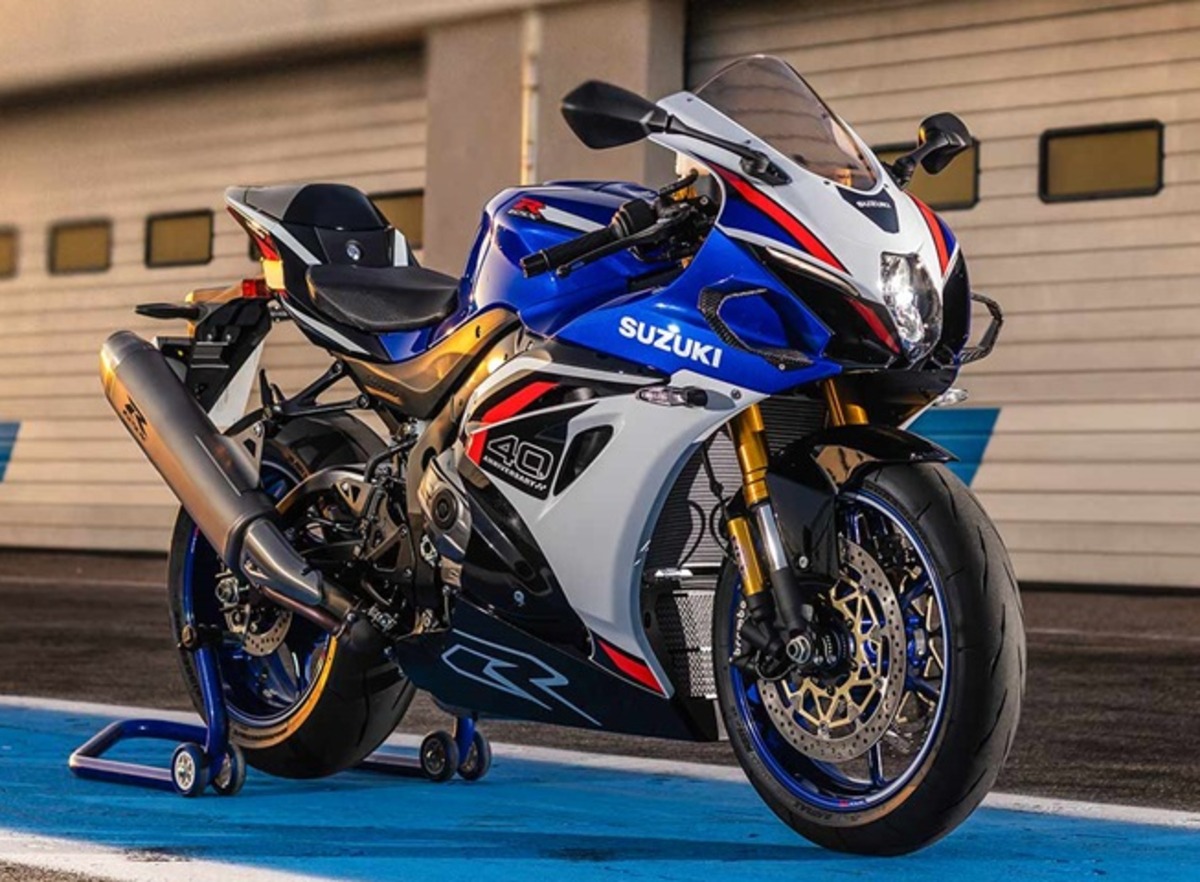
In this track review from Motorcycle.com, the reviewer takes the updated 2027 Suzuki GSX-R1000R through a brutal “Six Hours of Suzuki” simulation at the Monte Blanco circuit in Spain [00:17], [09:14].
This update represents a critical “welcome back” party for the Jixer 1000 in Europe (where it was dropped in 2023 due to emissions), while acting as a tiny, incremental evolution for the US market where it never left [00:32], [22:37].
The 2027 Sucuki GSX-R1000R Is Ready to Ride
Engine & Mechanical Updates
To meet stricter emissions regulations without sacrificing its core character, Suzuki updated the internals [00:47]:
- Revised Internals: Features reshaped, lighter pistons, stronger crank journals, and a different camshaft with reduced overlap to widen the torque spread [02:36], [03:53].
- Power Trade-off: The bike sacrifices a small amount of peak horsepower and torque, and the top-end power tends to “stall” slightly at high RPMs compared to the raw sprint power of past models [02:51], [16:23].
- Flow & Breathing: Features larger 48mm throttle bodies (up from 46mm) and slightly larger exhaust valves [03:23].
- Weight Reduction: Includes a standard lithium-ion battery (replacing lead-acid) and a smaller, 51g lighter ABS module [04:29], [04:43].
Electronics: The Real Advancement
The standout feature of this generation is the heavily revised electronics suite, heavily managed by a six-axis IMU [06:40]:
- Predictive Traction & Lift Control: The TC and wheelie control work seamlessly together. The reviewer noted that even when pinning the throttle on maximum lean, the TC light flashes but the system smoothly brings the front tire back down without any abrupt, unsettling cuts [18:13], [18:47].
- Refined ABS: The new module provides subtle, microscopic pulses at the brake lever when braking from 170 mph down to a 2nd-gear corner, a massive improvement over older, jarring systems [23:16], [23:41].
- Dual Quickshifter Modes: Mode 1 features longer ignition cut times optimized for smooth street shifting; Mode 2 features snappy, rapid kill times tailored for instant track downshifts [16:38].
Track Endurance Impressions
The reviewer survived four separate 25-to-40 minute stints, pushing a relentless pace [12:03], [13:26]. The ultimate takeaway was the GSX-R1000R’s legendary rideability. While other leader-class sportbikes physically drain the rider within a single session, the Suzuki’s linear power delivery (especially when dialed into “B-Mode” for endurance) and adaptable geometry make it uniquely easy to ride fast, hour after hour [15:08], [15:38], [26:26].
The mechanical package is robust; across six hours of continuous, full-throttle track torture by multiple teams, not a single bike suffered a mechanical failure [28:22].
My Thoughts on the 2027 Suzuki GSX-R1000R
Suzuki just built the ultimate “Analog” Digital Superbike.
Let’s be honest: visually, this bike is a time capsule. Suzuki left the fairings, fuel tank, frame, and Brembo brakes exactly the same as the 2017 model, slapped some obligatory 2026-era winglets on the front, and called it a day.
Suzuki’s laziness is exactly why this bike is brilliant. By refusing to completely redesign the frame or build a hyper-strung 210-horsepower engine, they preserved the most comfortable, reliable, and user-friendly chassis in the leader-bike class.
Instead of building a fragile, over-engineered track weapon that requires a degree in computer science to tune, they simply fixed the old bike’s biggest flaw, which was its dated electronics. The new predictive IMU gives you a digital safety net, but underneath, it’s still the same mechanical, linear, bulletproof sportbikes riders love.
