
Yamaha introduced the TX500 in 1972 as their first middleweight four-stroke twin. The 500cc vertical twin featured dual overhead camshafts, four valves per cylinder, and an Omni-phase balancer to manage vibration.
The bike was innovative for its era but suffered from excessive heat, warped valve seats, and cracked cylinder heads. Yamaha dropped the TX name after the TX750 failed, and the model later became the XS500.
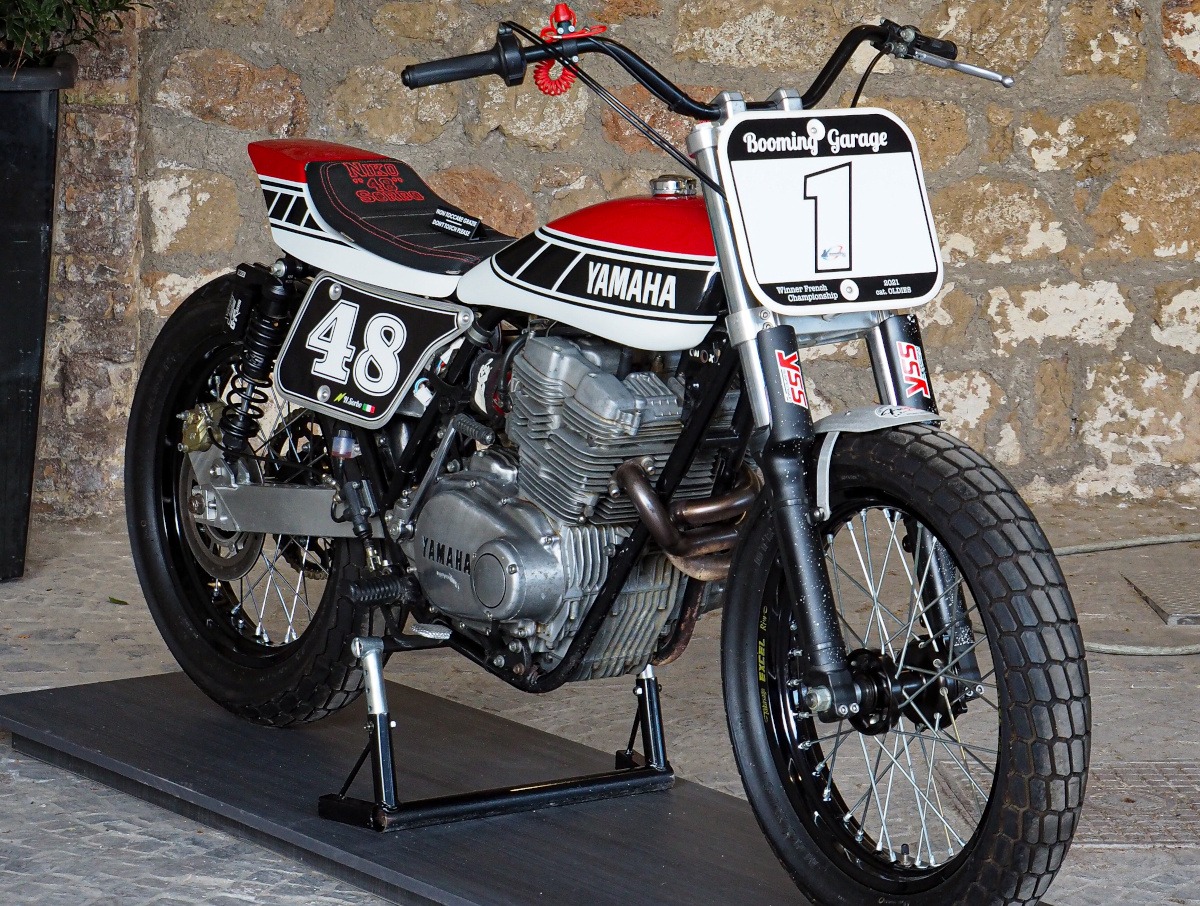
Professional flat track racer Niko Sorbo commissioned Massimo Rinchiuso of Italy’s Fuch’s Workshop to build a competition machine for the “Oldies” class. That category is reserved for pre-1975 twin-cylinder motorcycles.
Sorbo delivered the project as little more than a partially complete engine and a bare frame. Rinchiuso was initially skeptical about competing against Harley-Davidson XR750s with a Japanese 500 pulled from a basement box.
Building the FTX500
The frame was heavily modified, and Rinchiuso built practically everything else from scratch. Front forks come from a Yamaha R6 in custom CNC-cut triple clamps.
A modern aluminum dirt bike swingarm carries twin YSS shocks. Rinchiuso shaped the aluminum fuel tank and tail section by hand, one of his specialties.
Claudio Lanconelli of Lanko Tuning rebuilt the engine with heavy modifications. A custom electronic ignition was designed and built exclusively for this engine, and SC Project supplied the exhaust.
From Basement to Podium
The build proved far more competitive than Rinchiuso expected. Sorbo won back-to-back French championships aboard the FTX500 and took third in the German championship.
Rinchiuso described his own ride on the bike as “riding a surface-to-air missile with broken control fins.” He praised Sorbo’s ability to make the bike look manageable on the track.
The FTX500 appeared at the Eternal City Moto Show in Rome, where another Yamaha restomod also drew attention recently. Indoor photos of the FTX500 were shot by Tom Boissel, with outdoor photography by Christian Fussi.
Source: BikeBound
